Solutions

Automate PGA Screening and Message Set Population for Every Customs Entry

Cervo AI eliminates the manual burden of PGA data entry by auto-populating message sets for FDA, APHIS, EPA, AMS, FSIS, and more—directly from your parts library and commercial documents.

The Basics

What Is PGA Screening in Customs Entry?

Partner Government Agencies (PGAs) are federal bodies—such as the FDA, USDA/APHIS, EPA, CPSC, and FSIS—that regulate the import of specific goods into the United States. When a product falls under the jurisdiction of one or more of these agencies, customs brokers must include a PGA message set in the entry filing submitted through the Automated Commercial Environment (ACE).

Each PGA has its own message set with a unique combination of required data elements. An FDA message set, for example, requires product codes, prior notice confirmation numbers, and specific affirmation of compliance codes. An APHIS message set for a USDA-regulated agricultural product requires entirely different fields—permit numbers, species declarations, and country-of-origin phytosanitary details.

PGA screening is the process of determining which agencies have jurisdiction over a given import and then populating every required field for each applicable message set. It sits at the intersection of HTS classification, regulatory knowledge, and data entry—making it one of the most complex and error-prone steps in customs entry processing.

For a single entry line, a broker might need to complete a message set with 15 to 40 individual fields. Multiply that by dozens of lines across hundreds of entries per day, and the scale of the data entry challenge becomes clear. Incorrect or missing PGA data is one of the leading causes of CBP holds, intensive exams, and penalties at the border.

Why Manual PGA Processing Is Broken

Despite the critical importance of accurate PGA data, most customs brokerage operations still rely on manual processes to populate message sets. This approach creates compounding problems across the operation.

The Problem

The Hidden Costs of Manual PGA Data Entry

Every manual PGA field is an opportunity for error, delay, and wasted time. Here is what brokerage teams deal with daily.

Dozens of Agency-Specific Fields

Each PGA has its own message set schema with unique required fields. Brokers must know which fields apply to which product-agency combination and manually key every value. A single entry line with FDA, APHIS, and AMS requirements can demand 60 or more individual data points.

High Error Rates on Repetitive Entry

When entry clerks manually type program codes, product codes, and processing codes hundreds of times per day, keystroke errors are inevitable. A single wrong digit in an FDA product code can trigger a hold that delays an entire shipment for days.

Dynamic Data Scattered Across Documents

Static codes are only half the picture. PGA message sets also require dynamic information—packaging types, net quantities, unit of measure—that must be extracted from commercial invoices and packing lists for every shipment. Locating and transcribing this data is tedious and slow.

Multi-PGA Complexity

Many imported goods are regulated by more than one agency simultaneously. A food product might require FDA, APHIS, and AMS message sets on the same line. Managing overlapping requirements without a system that understands the full regulatory picture leads to missed filings and compliance gaps.

Importer-Specific Variations

PGA requirements can vary not just by product but by importer. Different importers may have different permits, registrations, and processing arrangements with the same agency. Tracking these variations manually across a client book is unsustainable at scale.

Training Bottleneck

PGA knowledge takes months or years to develop. New hires cannot be trusted with complex message sets without extensive oversight, creating a training bottleneck that limits how quickly a brokerage can grow its entry processing capacity.

The Solution

How AI Automates PGA Screening

Automating PGA screening requires solving two distinct problems. First, the system must know what PGA data applies to a given part—the static regulatory identity of the product. Second, it must extract shipment-specific dynamic data from the commercial documents that accompany each entry.

Traditional software tools attempted to address the first problem with lookup tables and static rules. But those approaches break down quickly because PGA requirements change, new products are introduced, and the sheer number of product-agency-importer combinations makes maintaining static mappings impractical.

AI changes the equation in three ways:

  • Intelligent part matching: Rather than relying on exact SKU lookups, AI can match parts from invoice descriptions to library records using contextual understanding, handling variations in naming, abbreviations, and formatting.
  • Document extraction: AI agents can read commercial invoices and packing lists to extract dynamic PGA fields—packaging types, quantities, weights, country of harvest, and more—without requiring standardized document formats.
  • Continuous learning: As brokers process more entries, the AI builds a deeper understanding of each importer's products and PGA requirements, becoming more accurate over time.

The result is a system that handles both the regulatory knowledge layer and the document processing layer in a single workflow, producing complete PGA message sets with minimal human intervention. For more on how PGA message sets are structured, see our resources on PGA message sets.

Cervo's Approach

Parts Library + AI Agents: A Complete PGA Automation System

Cervo treats PGA automation as a data architecture problem first and an AI problem second. The foundation is a parts library that stores PGA information on a per-part basis, combined with AI agents that handle extraction and population.

1

Per-Part PGA Storage in the Parts Library

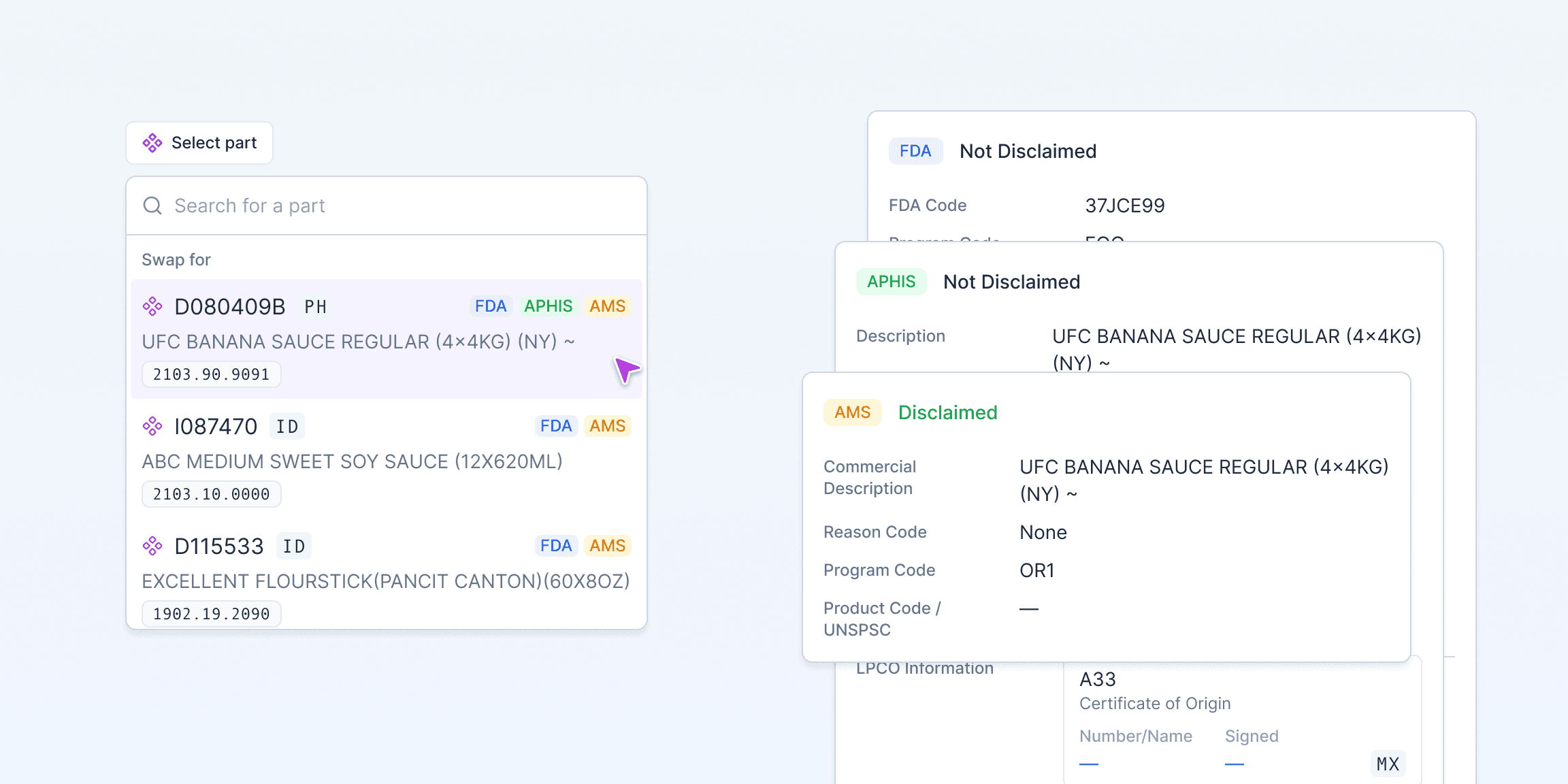
Every part in your Cervo parts library carries its full PGA profile. Static variables—program code, product code, processing code, and other fields tied to the product's regulatory identity—are stored directly on the part record. When that part appears on an entry, its PGA data is ready to go without any lookup or manual selection. This covers FDA, APHIS, AMS, EPA, FSIS, LACEY, and more.

2

AI-Powered Part Matching

When a new entry arrives, Cervo's AI matches line items from the commercial invoice to parts in your library. Once a match is confirmed, all static PGA fields for that part are auto-populated into the message set. No manual searching. No code lookups. The AI handles description variations, alternate names, and partial matches with confidence scores so your team can verify matches quickly.

3

Dynamic Field Extraction from Documents

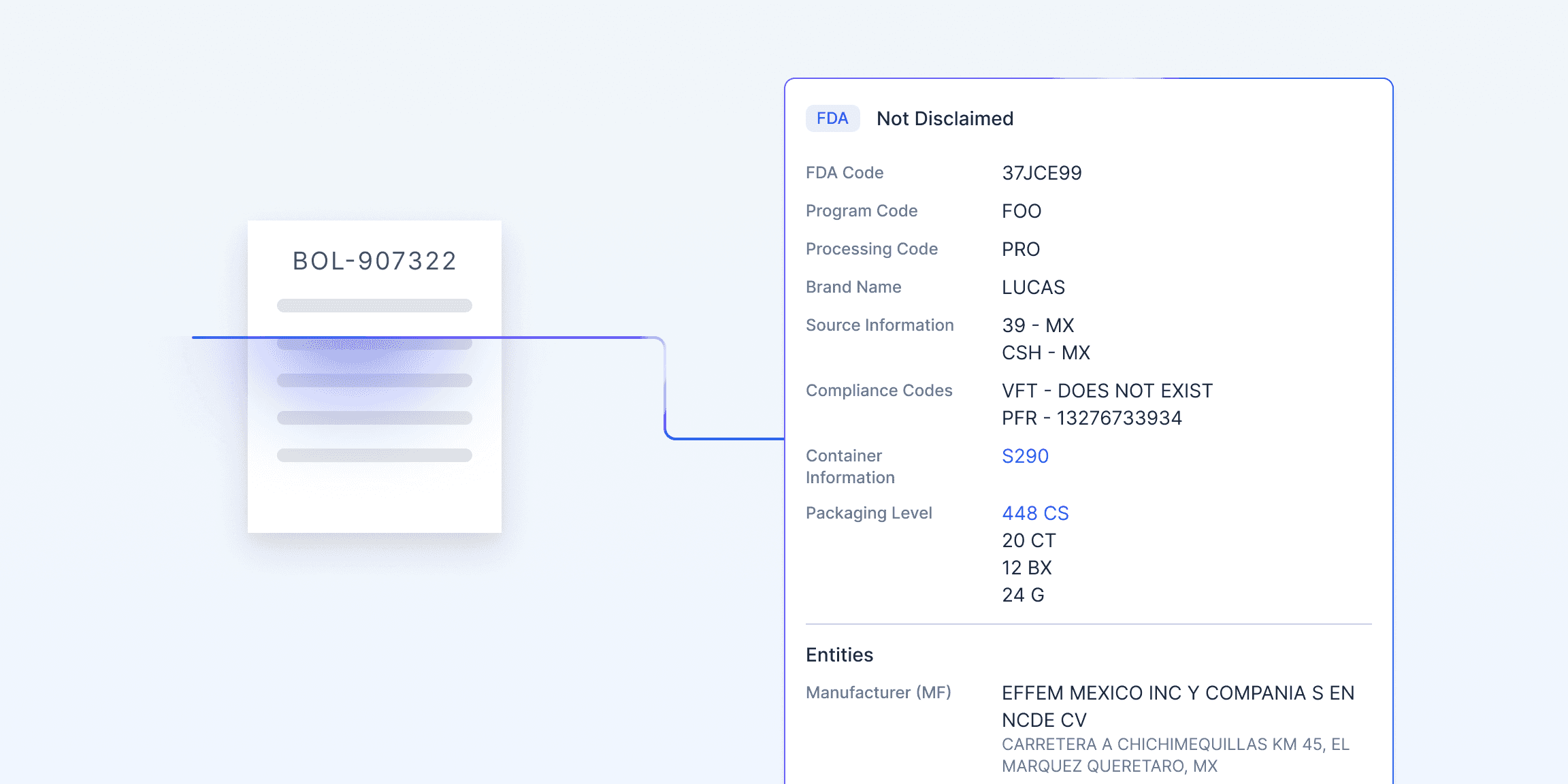
PGA message sets also require shipment-specific data: packaging information, net quantities, unit of measure, and other details that change with every shipment. Cervo's AI agents extract these dynamic variables directly from commercial invoices and packing lists. Each extraction carries a confidence score, so your team knows exactly where to focus review effort.

4

Per-Importer Agent Studio Customization

Different importers have different document formats, naming conventions, and PGA requirements. Cervo's Agent Studio allows you to customize PGA extraction rules on a per-importer basis. If one importer's invoices list packaging in a non-standard location, you can teach the agent where to find it—without affecting how the system processes entries for other importers.

5

Multi-PGA Handling

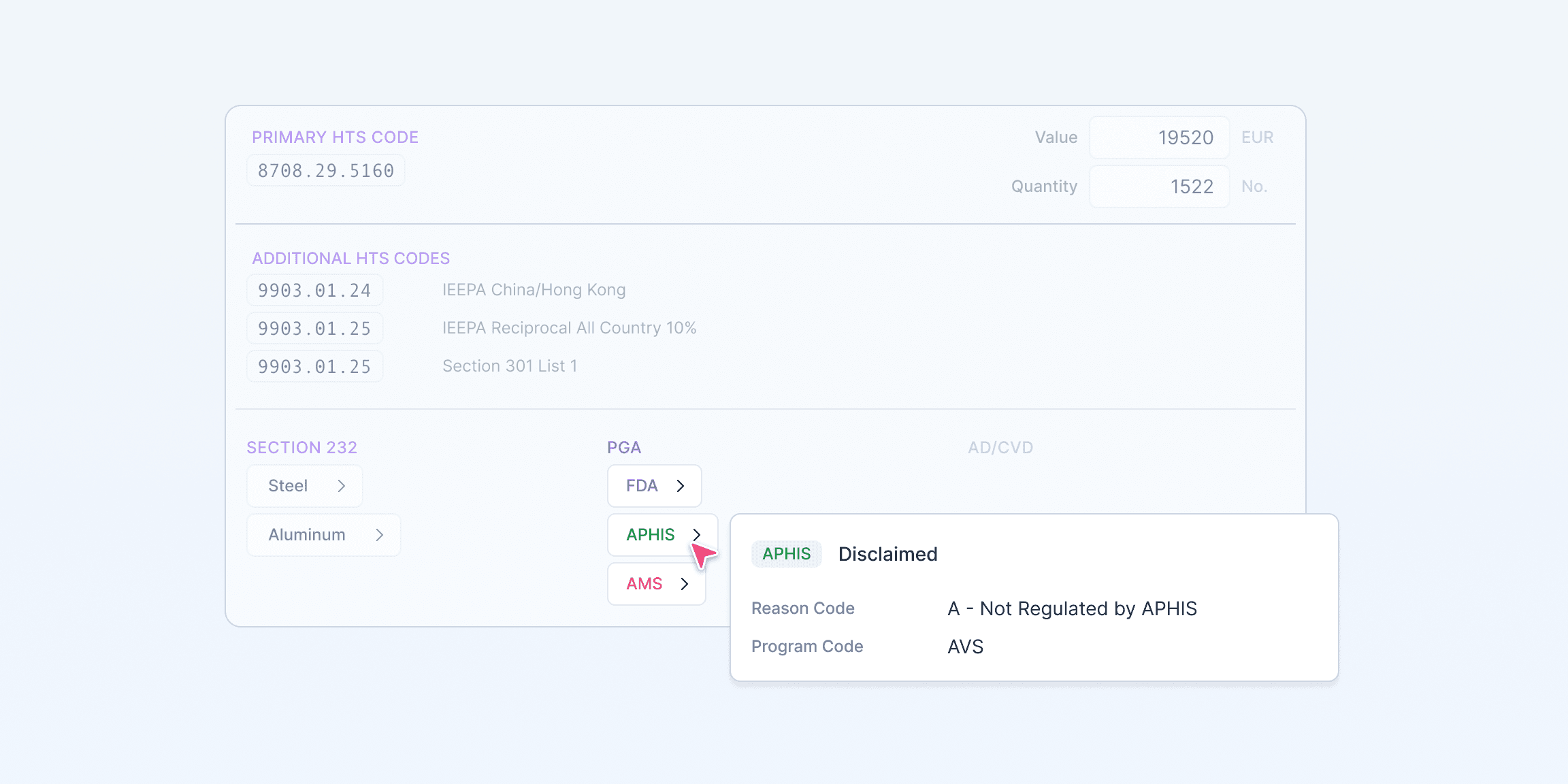
Many products are regulated by multiple agencies simultaneously. A single part might require FDA, APHIS, and AMS message sets filed together on the same entry line. Cervo handles multi-PGA scenarios natively—when a part is matched, all applicable message sets are populated at once, with no risk of missing an agency or mixing up fields between message sets.

6

Flexible Parts Library Building

Getting started does not require months of data migration. You can build your parts library from existing data you already maintain, from historical entries pulled from your ABI system, or incrementally during live processing using Cervo's "add to memory" feature. As you process more entries, your library grows and PGA automation coverage expands automatically.

Coverage

Supported Partner Government Agencies

Cervo supports the most commonly required PGA message sets today and is actively adding more. New PGAs can also be added during implementation based on your specific client book.

AgencyFull NameCommon ProductsStatus
FDAFood and Drug AdministrationFood, drugs, medical devices, cosmetics, dietary supplementsLive
APHISAnimal and Plant Health Inspection ServiceAgricultural products, plants, animals, wood packagingLive
AMSAgricultural Marketing ServiceFresh fruits, vegetables, dairy, poultry, livestockLive
EPAEnvironmental Protection AgencyChemicals, pesticides, motor vehicles, enginesLive
FSISFood Safety and Inspection ServiceMeat, poultry, processed egg productsLive
LACEYLacey Act CompliancePlants, plant products, wood products, timberLive
CPSCConsumer Product Safety CommissionConsumer products, toys, electronics, household goodsComing Soon
NHTSANational Highway Traffic Safety AdministrationMotor vehicles, tires, child restraints, auto partsComing Soon

Static vs. Dynamic PGA Variables

Cervo categorizes PGA data elements into two types to optimize how they are stored and populated:

  • Static variables are fields tied to the identity of the product itself. These include program codes, product codes, processing codes, and other agency-specific identifiers that remain the same every time a particular part is imported. These are stored in the parts library and auto-populated on match.
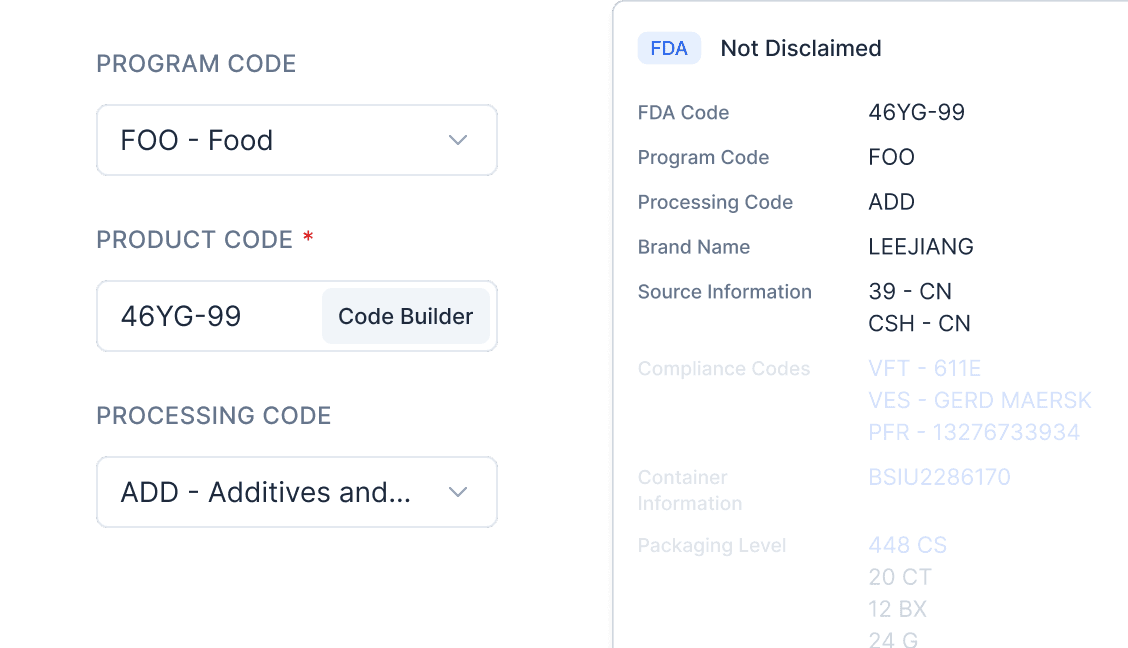
  • Dynamic variables are fields that change with each shipment. Packaging type, net quantity, unit of measure, container dimensions, and similar details are extracted by AI agents from the commercial invoice and packing list accompanying each entry.
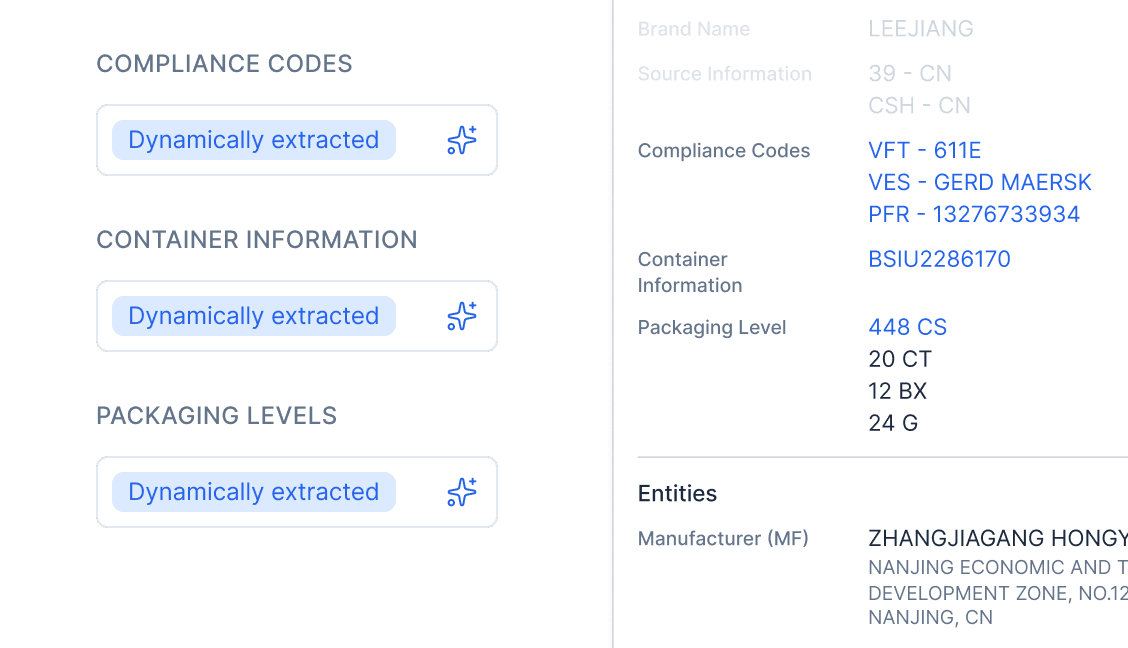
This two-layer approach means you only need to set up static PGA data once per part, while shipment-specific data is handled automatically for every new entry. The combination eliminates the vast majority of manual PGA data entry.

Workflow Integration

PGA Automation as Part of End-to-End Entry Processing

PGA screening does not happen in isolation. It is one step in the broader customs entry workflow—and Cervo treats it that way. When an entry arrives in the system, the following happens:

  1. Document intake: Commercial invoices, packing lists, and other documents are ingested and parsed by AI agents.
  2. Part matching: Line items are matched to parts in your library, pulling HTS classifications and PGA profiles simultaneously.
  3. Static PGA population: All stored PGA message set fields are auto-filled for each matched part.
  4. Dynamic PGA extraction: AI agents extract shipment-specific fields (packaging, quantities, etc.) from the commercial documents.
  5. Confidence scoring: Every populated field receives a confidence score. High-confidence fields pass through; lower-confidence fields are flagged for review.
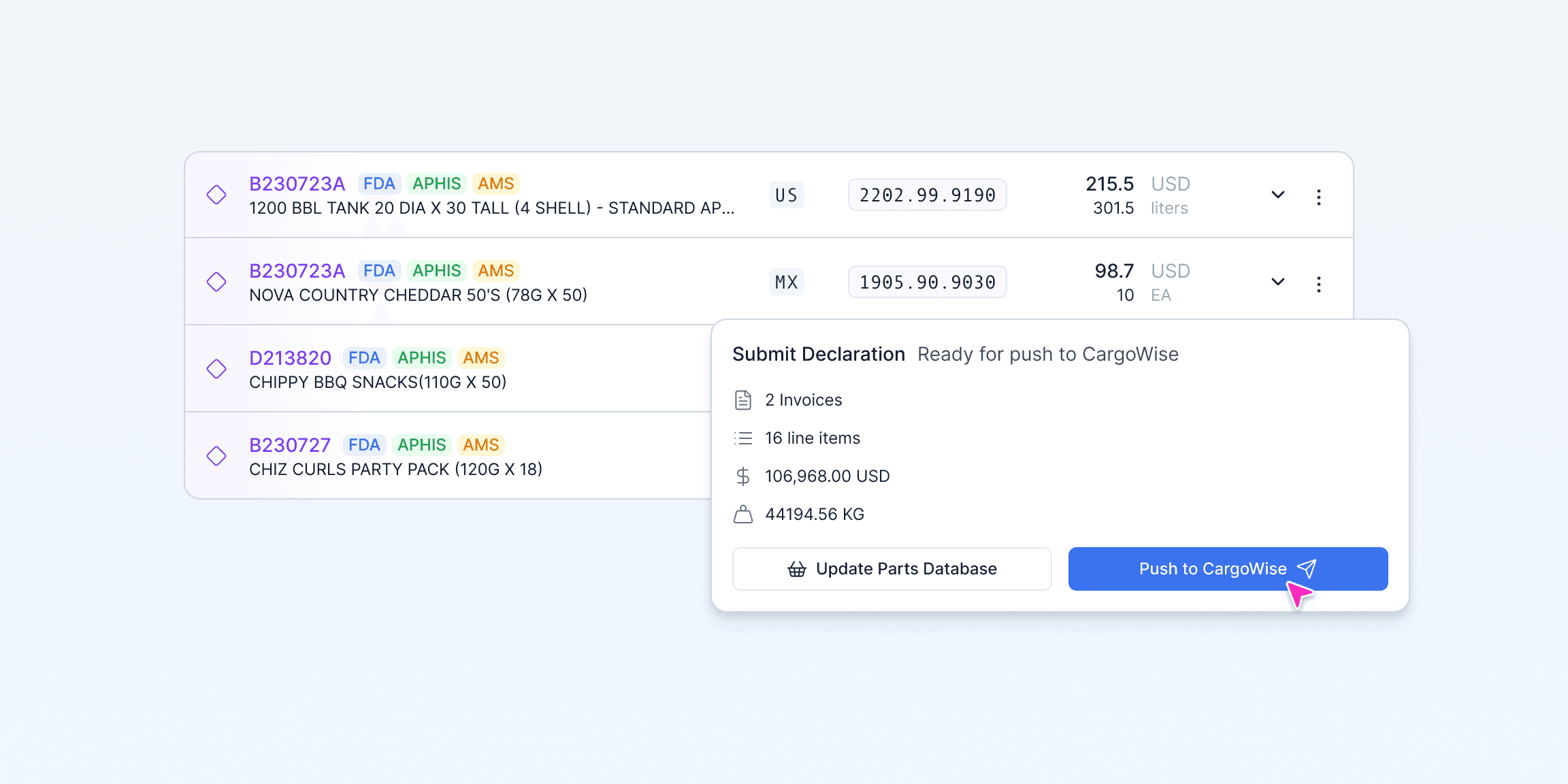
  6. Human review: Your team reviews flagged items and approves the completed entry, including the fully populated 7501 form and all PGA message sets.

This workflow means PGA data is populated in the same pass as HTS classification and other entry data—not as a separate, downstream step. The result is faster end-to-end processing with fewer handoffs and less rework.

Building Your Parts Library Over Time

One of the most common concerns about PGA automation is the upfront effort required to build the underlying data. Cervo addresses this with three onboarding paths:

  • Existing data import: If you already maintain product databases, code sheets, or PGA reference files, Cervo can ingest them directly into the parts library.
  • Historical entry pull: Cervo can extract part and PGA data from historical entries in your ABI system, pre-populating the library with products you have already processed.
  • Incremental "add to memory": During live entry processing, your team can add new parts to the library on the fly. Each time you process a new product, it becomes part of your permanent library for all future entries.

Most teams use a combination of all three approaches, reaching high automation coverage within weeks rather than months.

Results

What Automated PGA Screening Delivers

Brokerages using Cervo for PGA automation report measurable improvements across their entry operations.

90%+
Reduction in PGA data entry time
3x
More entries processed per clerk per day
Near Zero
PGA-related holds from data entry errors
Weeks
To full PGA automation coverage, not months
FAQs

Frequently Asked Questions

CTA Background

Stop Keying PGA Data by Hand

See how Cervo auto-populates PGA message sets for FDA, APHIS, EPA, AMS, FSIS, and more—directly from your parts library and commercial documents.
Automate PGA Screening | Customs AI | Cervo