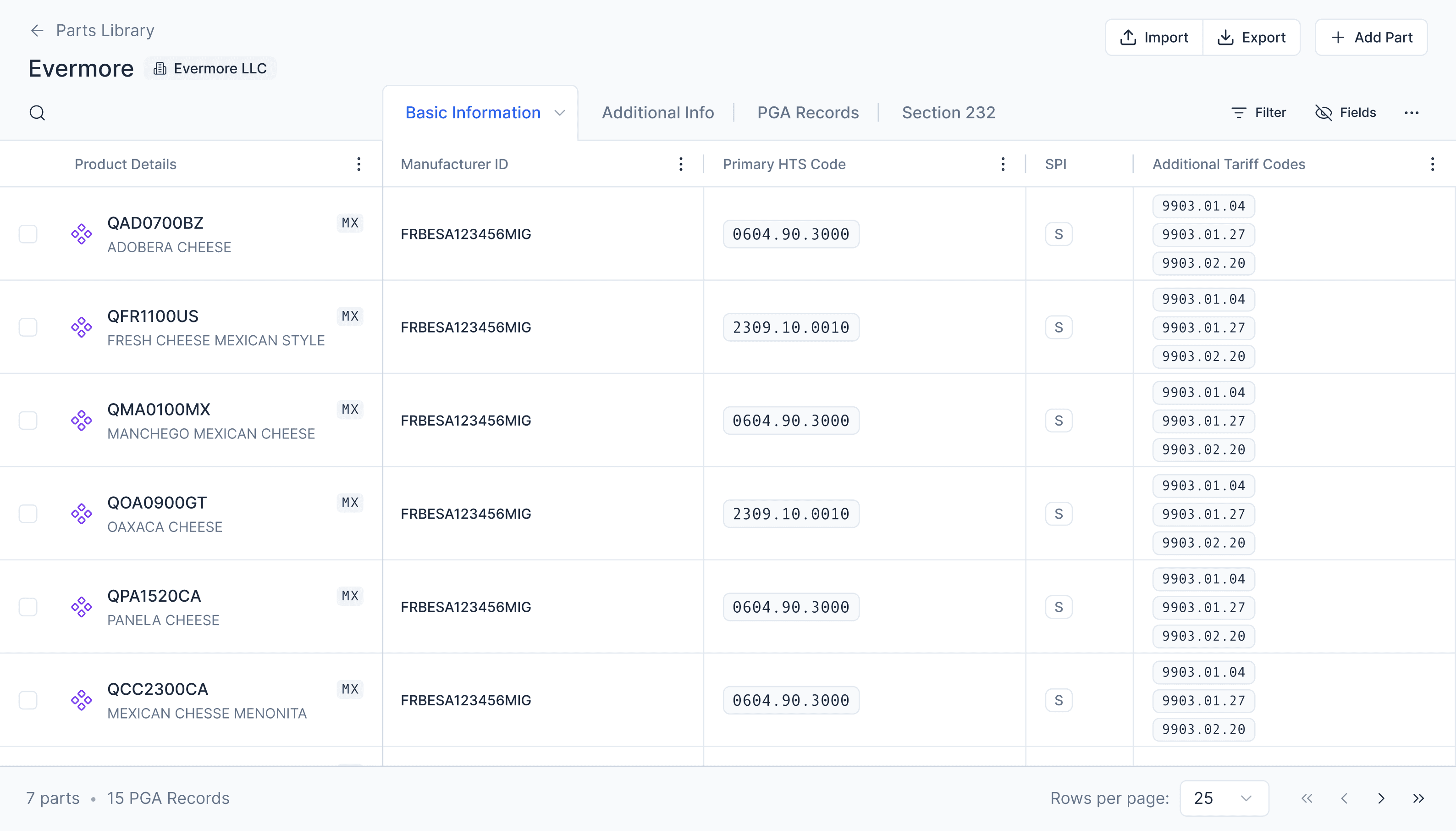
Cervo's parts library is a centralized customs classification database that stores HTS codes, PGA requirements, and product data for every item your brokerage has ever processed. Organized on a per-importer basis and viewable by the whole team with admin access controls, it delivers 95%+ accuracy on part matching. When a returning product appears, classification data auto-populates - no reclassification needed.
Most customs brokerages have no central database for classification decisions. The result is wasted time, inconsistent entries, and institutional knowledge that disappears when employees leave.
Your most experienced entry writers know the correct HTS codes, PGA flags, and steel split configurations for hundreds of products - but that knowledge lives only in their heads. When they are out sick, on vacation, or leave the company, that classification intelligence walks out the door with them. New hires start from scratch, re-researching products the team classified years ago.
Without a structured customs classification database, brokerages rely on informal systems - personal spreadsheets, sticky notes, email threads, or simply asking a senior colleague. These systems are fragile, unsearchable, and impossible to maintain at scale. When an importer ships the same product through a different port or on a different entry type, your team may classify it differently each time.
The customs brokerage industry faces chronic staffing challenges. Every time an entry writer leaves, the brokerage loses not just a team member but years of accumulated classification decisions. Rebuilding that knowledge base takes months of training and countless hours of redundant research - time your team cannot afford when entry volumes keep growing.
Cervo's HTS code database builds itself from your historical entries and gets smarter with every shipment your team processes.
When you connect Cervo to your brokerage, the platform ingests your historical entry data and automatically populates the parts library. Every product, every HTS code, every PGA requirement, every unit value - captured and organized without any manual data entry. For faster initial setup, brokers can also export from Google Sheets and upload a CSV to populate the database quickly. Your classification history becomes a searchable, structured database on day one.
When a new shipment arrives, Cervo scans the commercial invoice and matches each line item against the parts library. The system uses fuzzy matching to handle real-world part number variations - appended PO numbers, truncated codes, formatting differences, and other inconsistencies that trip up exact-match systems. If product ABC-1234 was classified before, Cervo recognizes ABC-1234-PO5678 as the same item.
For every matched product, Cervo auto-populates the HTS code, PGA requirements, steel split configuration, country of origin rules, and historical unit values directly into the entry. Your entry writers review pre-filled data instead of researching from scratch - turning a 15-minute classification task into a 15-second review.
Every entry your team processes enriches the parts library. The database is dynamic and auto-updating: as entry writers complete entries and make changes - a new tariff code, an updated PGA requirement - the parts library automatically reflects those updates. Mid-entry, entry writers can also click "add to memory" to save a new part back to the centralized database for future matching. The library grows more comprehensive and more accurate over time.
A complete customs parts library that captures, organizes, and applies your brokerage's classification intelligence at scale.
No manual data entry required. The parts library populates itself from your historical entries, capturing HTS codes, product descriptions, unit values, and classification decisions your team has already made. For initial setup, brokers can also upload a CSV export from Google Sheets. The database is dynamic and auto-updating - as entry writers complete entries and make changes, the library reflects those updates in real time. Your entire entry history becomes a searchable knowledge base.
Real-world part numbers are messy. Cervo's fuzzy matching handles appended PO numbers, truncated codes, added suffixes, spacing differences, and other formatting variations that prevent exact-match systems from identifying returning products. The engine achieves 95%+ accuracy on part matching, with fewer than 5% of matches requiring manual correction.
Every record in the parts library stores the full classification profile: HTS code, PGA requirements, steel split configurations, country of origin, unit values, product descriptions, and any Agent Studio rules applied to the product.
The parts library cross-references incoming values against historical data to flag statistical outliers. If a product's declared value deviates significantly from its historical range, Cervo alerts your team before the entry is filed - catching data entry errors and invoice discrepancies early.
Classification data is organized on a per-importer basis, so each client's product catalog is maintained separately. The library is centralized and viewable by the whole team, with admin access controls governing who can edit classification data. When importer-specific HTS rulings, PGA exemptions, or duty preference programs apply, the parts library stores and applies the correct configuration for each account.
The parts library works hand-in-hand with Agent Studio, Cervo's custom rules engine. Classification rules, tariff overrides, and compliance checks defined in Agent Studio are stored alongside parts library data, ensuring every entry reflects both historical precedent and current business logic.
Brokerages using Cervo's parts library eliminate redundant classification work and build a durable knowledge base that scales with their business.
For most brokerages, 60-80% of line items on any given entry are products the team has classified before. With the parts library, those line items are handled automatically - letting your team focus their expertise on genuinely new products and complex classifications.