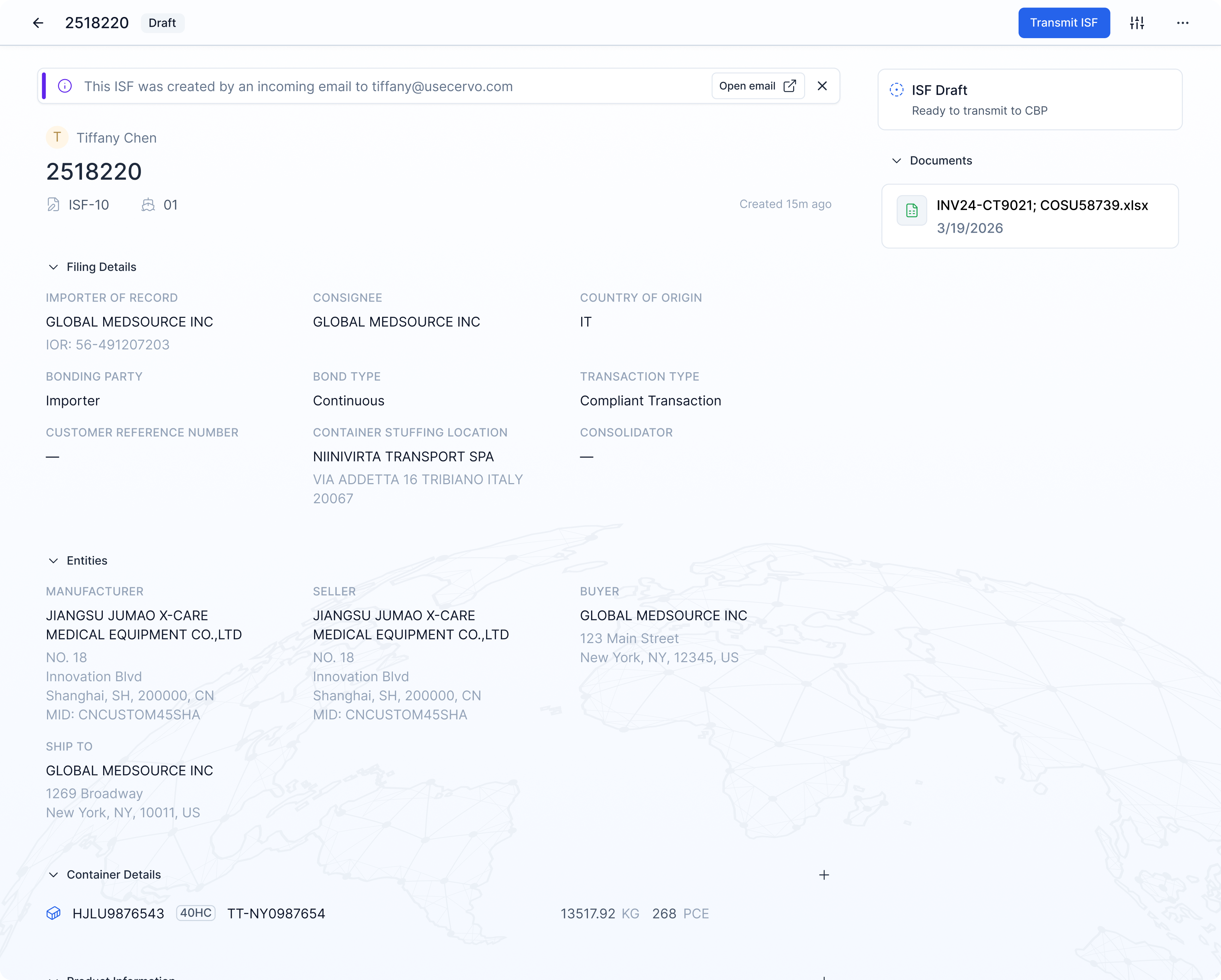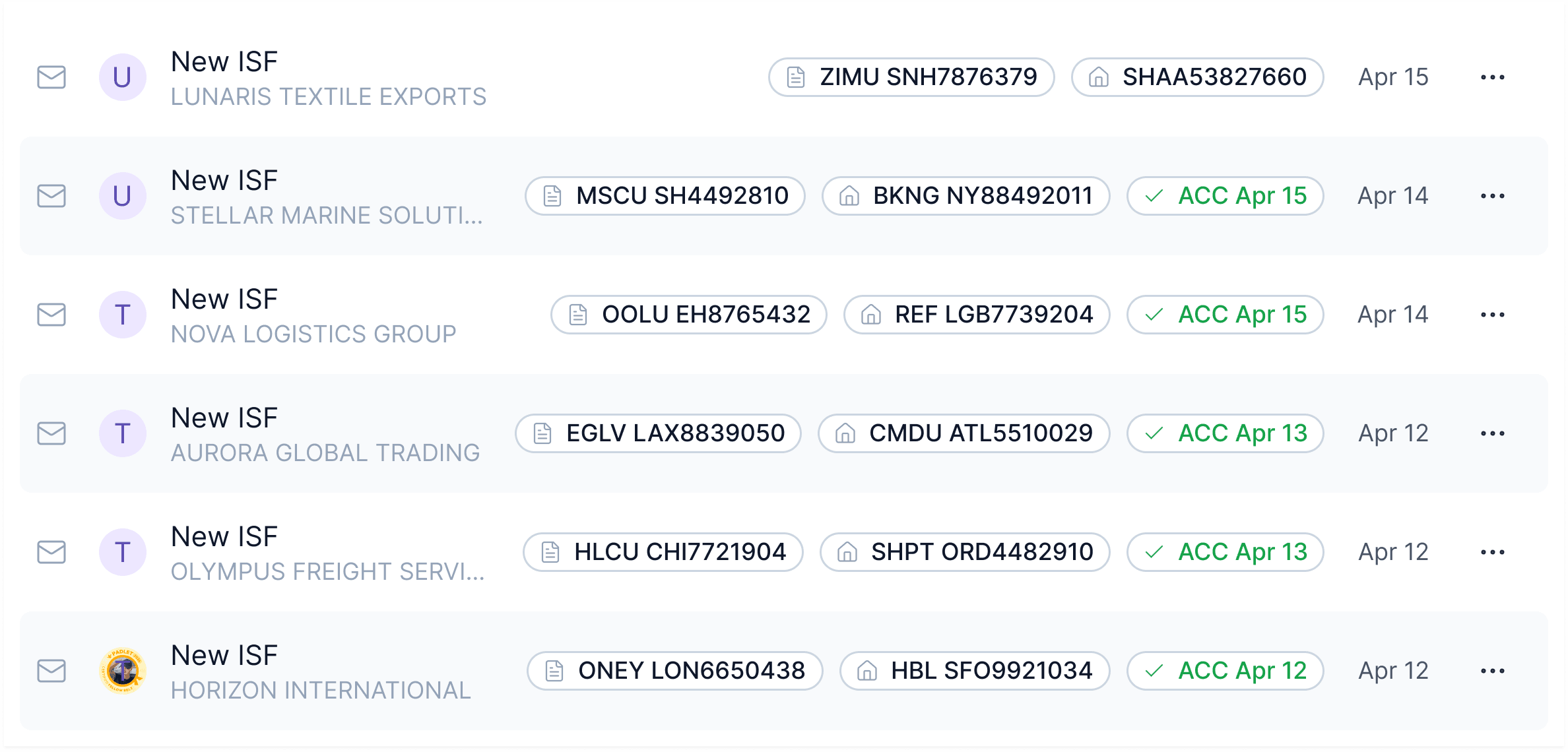
Extract all 10+2 data elements from any document format in 2-10 minutes. File accurate Importer Security Filings at scale with confidence scoring, compliance guardrails, and direct ABI integration.
Importer Security Filing (10+2) demands accuracy across 10 distinct data elements, all filed at least 24 hours before vessel loading. For brokerages processing hundreds or thousands of shipments, the manual burden is unsustainable.
Every ocean shipment requires an ISF filed no later than 24 hours before cargo is loaded at the foreign port. With documents arriving late, in inconsistent formats, and often incomplete, brokers face a relentless race against the clock. A single missed deadline can cascade into holds, penalties, and damaged client relationships.
CBP enforces ISF compliance aggressively. Inaccurate, late, or incomplete filings can result in penalties of $5,000 or more per violation. For brokerages handling high volumes, even a small error rate translates into significant financial exposure. Repeated violations escalate scrutiny and can lead to cargo holds and liquidated damages.
The 10 required data elements (manufacturer, seller, buyer, ship-to, container stuffing location, consolidator, importer of record, consignee, country of origin, and HTS code) are scattered across bills of lading, commercial invoices, packing lists, and shipper correspondence. Documents arrive as PDFs, scanned images, spreadsheets, or forwarded emails, each requiring manual review and cross-referencing.
ISF preparation requires experienced staff who understand trade compliance nuances. As filing volumes grow, brokerages struggle to recruit and retain qualified personnel. Each new hire needs months of training before they can work independently, and even experienced staff make errors under time pressure.
Seasonal peaks, new client onboarding, and supply chain shifts cause filing volumes to spike unpredictably. Manual processes cannot scale elastically. Brokerages are forced to choose between overtime costs, temporary staff with higher error rates, or delayed filings that risk penalties.
Without automation, ISF data lives in emails, spreadsheets, and individual brokers' notes. Auditing past filings, tracking amendment history, and responding to CBP inquiries requires time-consuming manual searches across disconnected systems.
Automating ISFs eliminates the manual bottleneck between receiving shipping documents and transmitting a compliant filing to CBP. Here is how an AI-driven workflow transforms ISF processing.
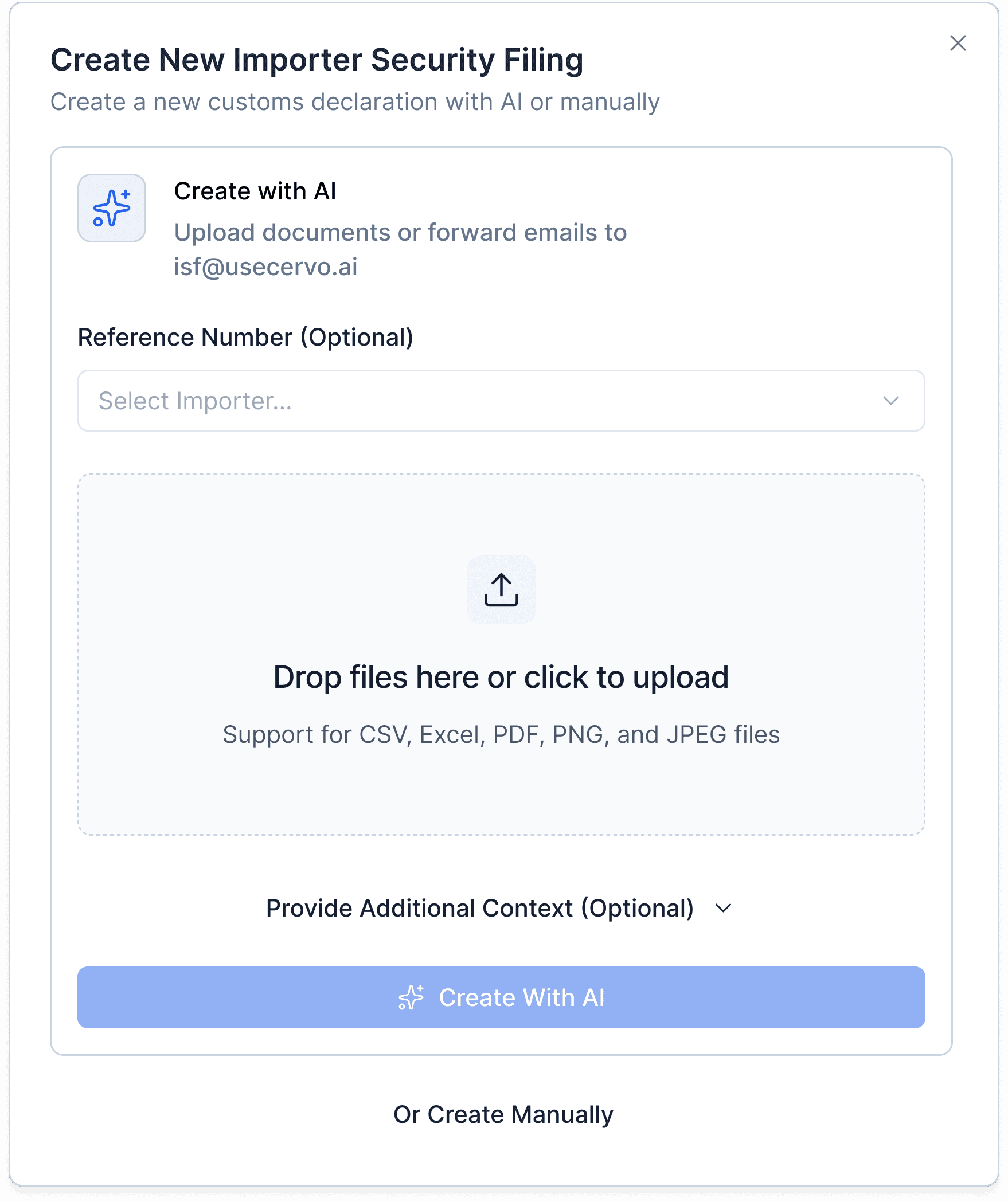
Drag and drop files, forward emails, or connect via API. The system accepts PDFs, scanned images, Excel, CSV, and even handwritten documents. Multi-page files are automatically split and classified by document type.
AI reads each document and maps the extracted data to the required ISF fields: manufacturer name and address, seller, buyer, ship-to party, container stuffing location, consolidator, importer of record, consignee, country of origin, and HTS classification.
Each field receives a confidence score with a plain-language explanation. Known parts are enriched from a parts library with stored HTS codes, manufacturer details, and country of origin. Compliance guardrails flag inconsistencies before transmission.
Approved filings are transmitted through your existing ABI system or exported in the format your workflow requires. Integration with CargoWise, One View, and other platforms via API, XML, SFTP, or CSV keeps your current processes intact.
Cervo is an AI platform designed specifically for trade compliance workflows. Every capability is built to handle the complexity and precision that ISF filing demands.
PDFs, PNGs, Excel spreadsheets, CSVs, rescanned faxes, and handwritten notes. Cervo's AI handles them all without requiring templates or pre-configuration. Multi-page documents are automatically split and classified.
Each extracted data element includes a confidence score and a human-readable explanation of how the value was determined. Your team reviews with context rather than guessing, reducing review time while maintaining accuracy.
For repeat shipments and known commodities, Cervo auto-populates HTS codes, manufacturer information, and country of origin from your parts library. This accelerates processing and ensures consistency across filings.
Every importer and shipper has unique requirements. Agent Studio lets you define per-client processing rules in plain language: "For shipments from Supplier X, always use this manufacturer address" or "Flag HTS codes in Chapter 85 for secondary review."
Before any filing is transmitted, Cervo runs validation checks against CBP requirements. Missing fields, format issues, and data inconsistencies are caught and flagged, preventing costly rejections and penalties.
Cervo connects to your existing ABI-certified systems including CargoWise and One View. Data flows via API, XML, SFTP, or CSV export, fitting into your established transmission workflow without disruption.
Process tens of thousands of ISF filings simultaneously. Volume spikes from seasonal peaks or new client onboarding are handled without additional staff or overtime. The platform scales with your business.
SOC2 Type 2 and ISO 27001 certified. Your clients' trade data is protected with the same rigor you apply to their filings. Audit trails and access controls meet the requirements of the most security-conscious importers.
Cervo automates ISF filing as part of a broader customs automation platform. The same AI that extracts ISF data elements also powers 7501 entry processing and full customs entry automation, giving your brokerage a unified workflow from pre-arrival filing through final liquidation.
When ISF data is captured by AI, it becomes the foundation for downstream entry work. HTS classifications, manufacturer details, and party information flow directly into your 7501 preparation, eliminating redundant data entry and ensuring consistency between your security filing and your entry documentation. This integrated approach means every document you process builds on what the platform already knows about the shipment.
Brokerages that use AI to automate ISFs consistently report measurable improvements across speed, accuracy, and capacity.

AI-powered extraction and preparation of CBP Form 7501 customs entries, from commercial invoice to filing-ready entry summary.
Automated Harmonized Tariff Schedule classification with AI confidence scoring and parts library enrichment for consistent, defensible codes.
See the full Cervo AI platform and how automating ISFs fits into the end-to-end customs workflow.