Solutions

Automate 7501s with AI That Understands Customs

Cervo AI turns commercial invoices, packing lists, and bills of lading into draft-ready 7501 entry summaries in minutes. Reduce processing time by 80% while strengthening compliance.

The Challenge

Manual 7501 Processing Is Holding Your Brokerage Back

A single CBP Form 7501 requires data from multiple source documents. An entry writer must locate each document, extract relevant fields, determine the correct HTS classification, calculate duties across multiple Chapter 99 provisions, and verify that everything reconciles. For a moderately complex entry, this takes 30 to 60 minutes. For steel entries or goods subject to AD/CVD duties, substantially longer.

Multiply that across your team. If your brokerage processes 500 entries a week at 40 minutes each, that is over 330 hours of labor consumed by data extraction and keying—the equivalent of eight full-time employees. The labor shortage in customs brokerage makes this worse every year. Experienced entry writers are difficult to recruit, expensive to train, and when they leave, they take institutional knowledge about specific importers and commodities with them.

The tariff environment has made this significantly harder. Between Section 301, Section 232, IEEPA, and AD/CVD orders, the number of duty layers on a single line item has increased dramatically. Getting the stacking sequence wrong means either overpaying or creating compliance liability for both the importer and the broker.

How It Works

From Document to Draft Entry in Minutes

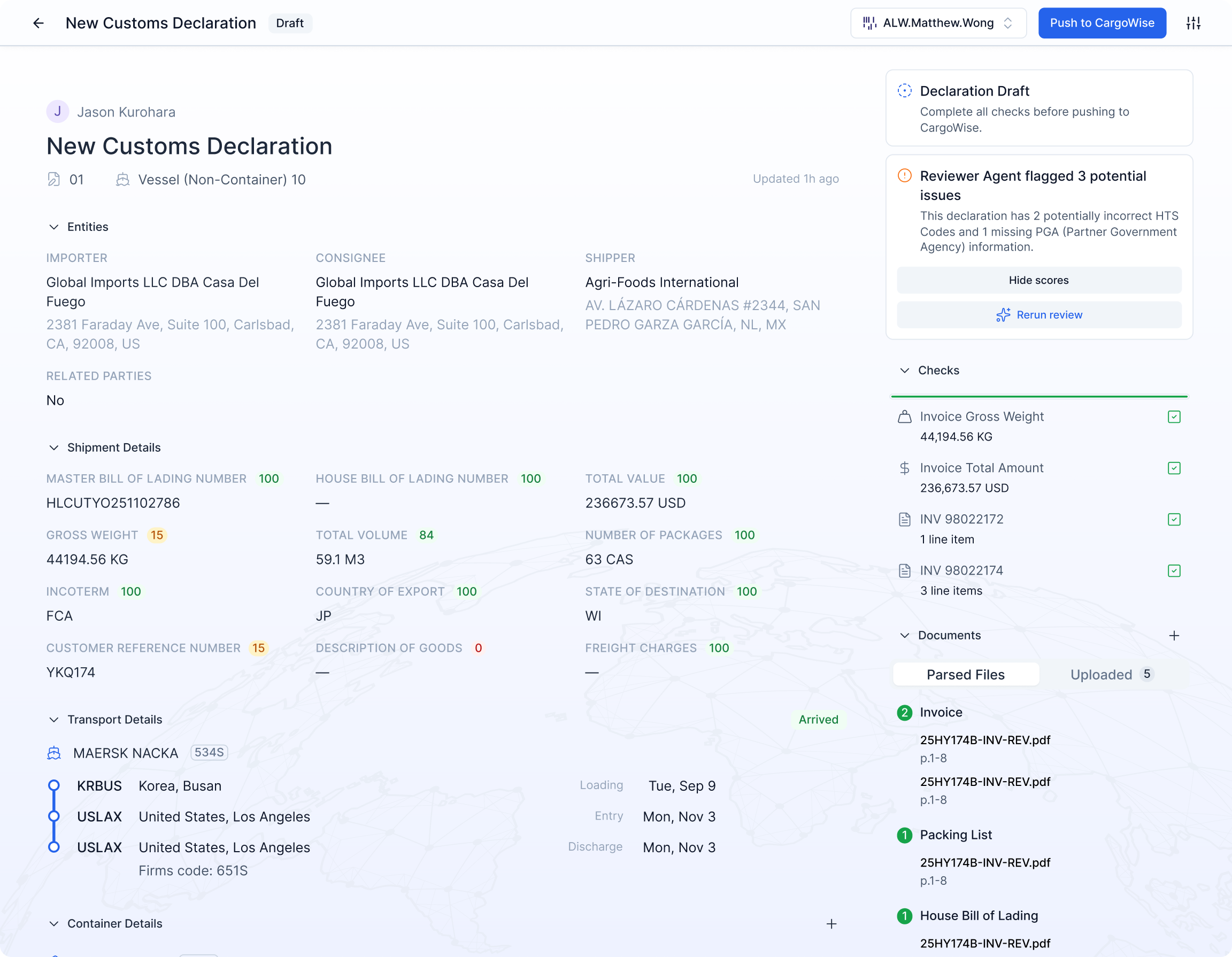
Cervo ingests the same source documents your entry writers use and produces a draft-ready 7501. The difference is speed and consistency: 2 to 10 minutes instead of 30 to 60, with confidence scores on every field so your team reviews instead of rebuilds.
1

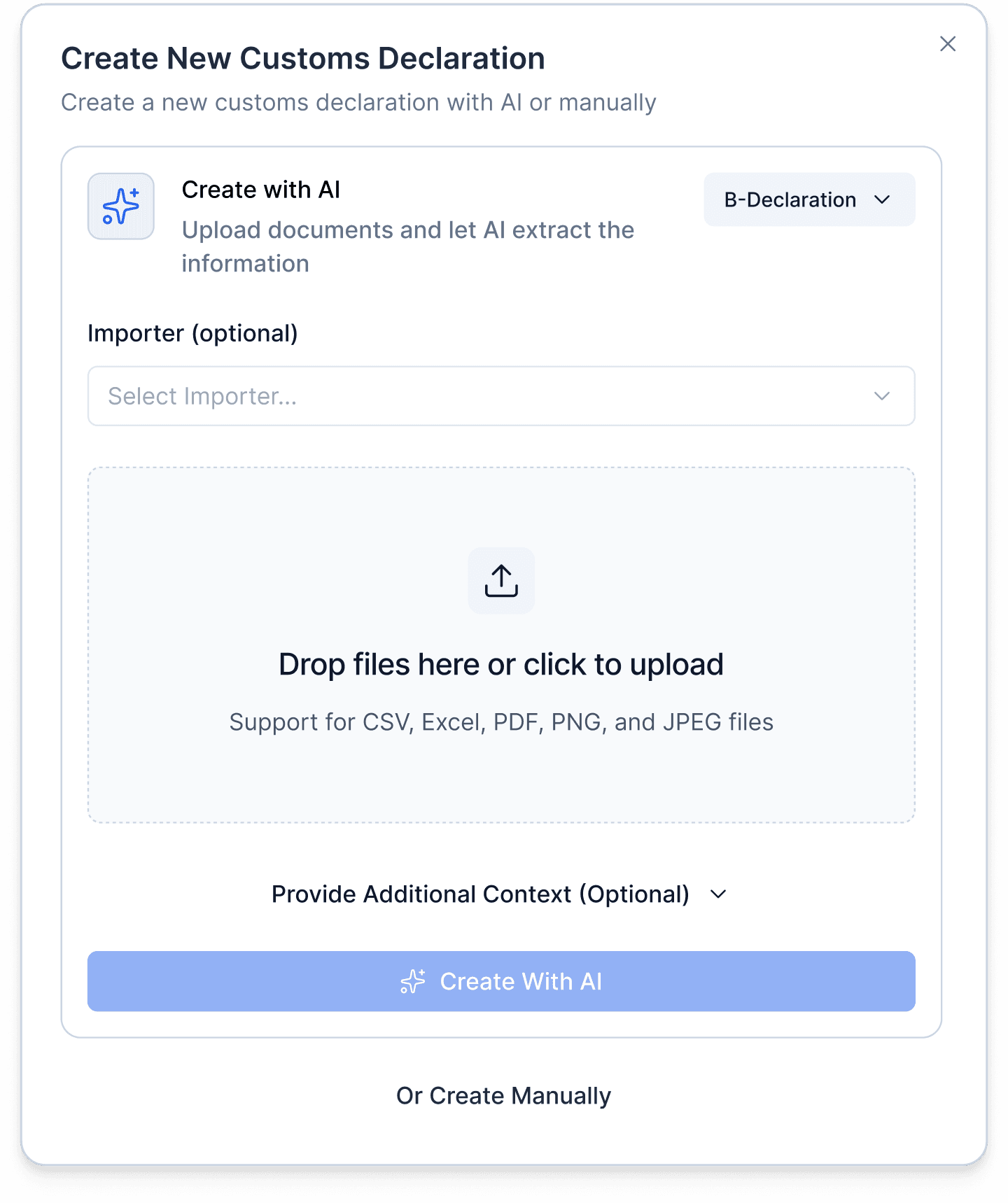
Upload Documents

Drag and drop or forward via email. Cervo accepts PDFs, PNGs, Excel, CSVs, and handwritten documents. Multi-page files are automatically split and classified by document type.

2

AI Extracts All Fields

Header-level data (importer, consignee, shipper, transport details) and line-item detail (descriptions, quantities, weights, values, country of origin) are extracted with confidence scores and reasoning.

3

Classify, Stack, and Validate

HTS codes are recommended, Chapter 99 tariffs stacked, PGA requirements screened, steel splits calculated, and compliance guardrails applied—all automatically. Built-in invoice reconciliation checks invoice total vs. declared value, verifies line item amounts match the invoice, and validates gross weight matching to catch discrepancies before filing.

4

Review and Push Draft-Ready 7501 to ABI

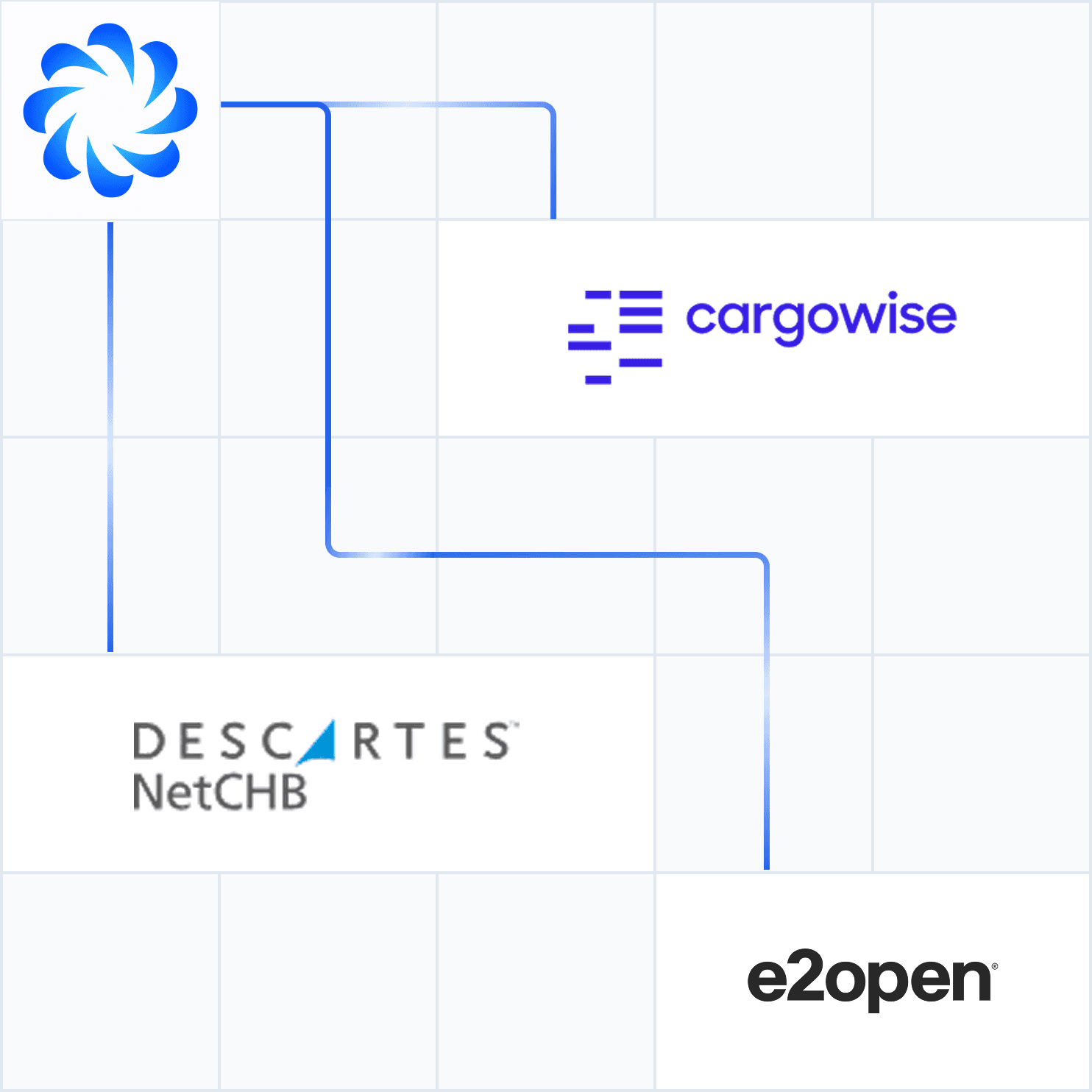
Your entry writer reviews the draft-ready 7501 using a side-by-side document view for verification, confirms edge cases, and pushes directly to CargoWise, One View, NetCHB, or other ABI systems with a single click. Need to add documents mid-process—for example, when an arrival notice comes in later? Just add them to the existing declaration and the system updates accordingly.

HTS & Tariffs

HTS Classification and Tariff Stacking

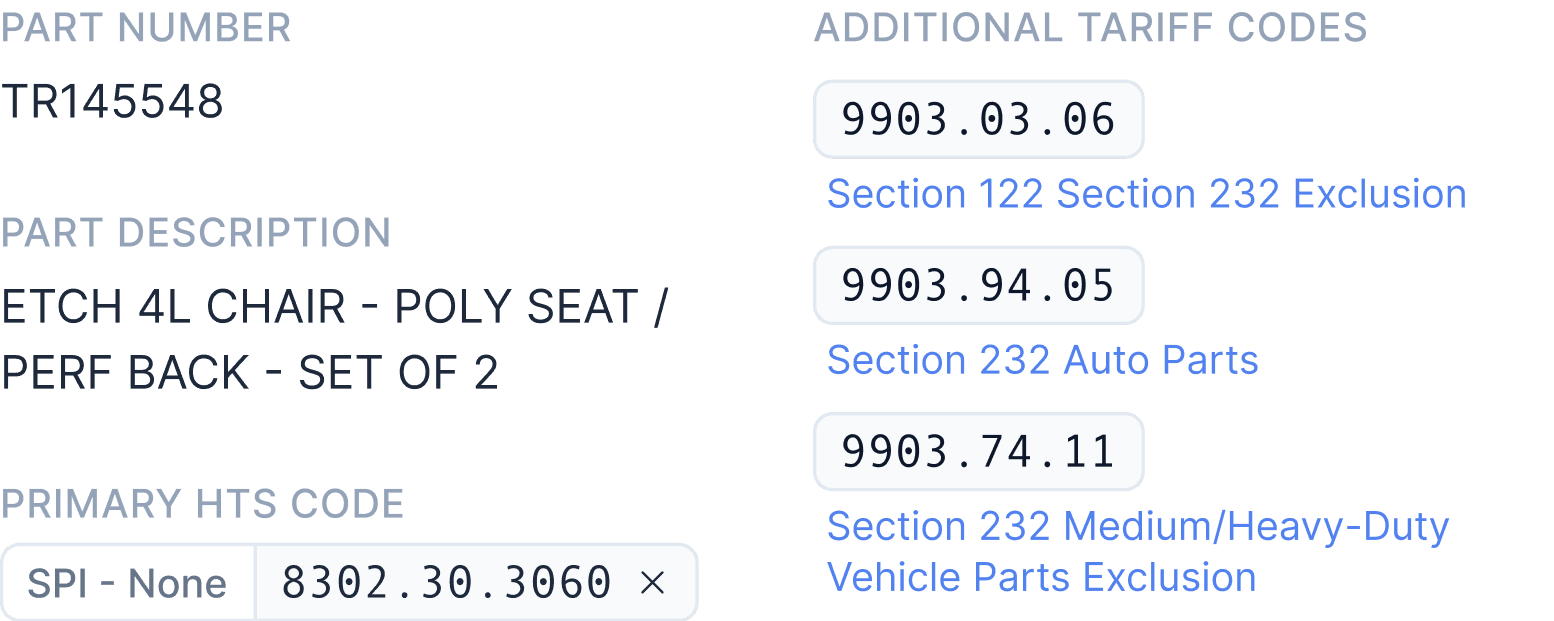
The Harmonized Tariff Schedule contains over 17,000 subheadings, and recent trade policy has layered Chapter 99 provisions on top. A single entry line may require the correct application of a base HTS duty rate plus Section 301, Section 232, IEEPA, and AD/CVD duties. The stacking order matters, the exclusion logic matters, and the rates change frequently.

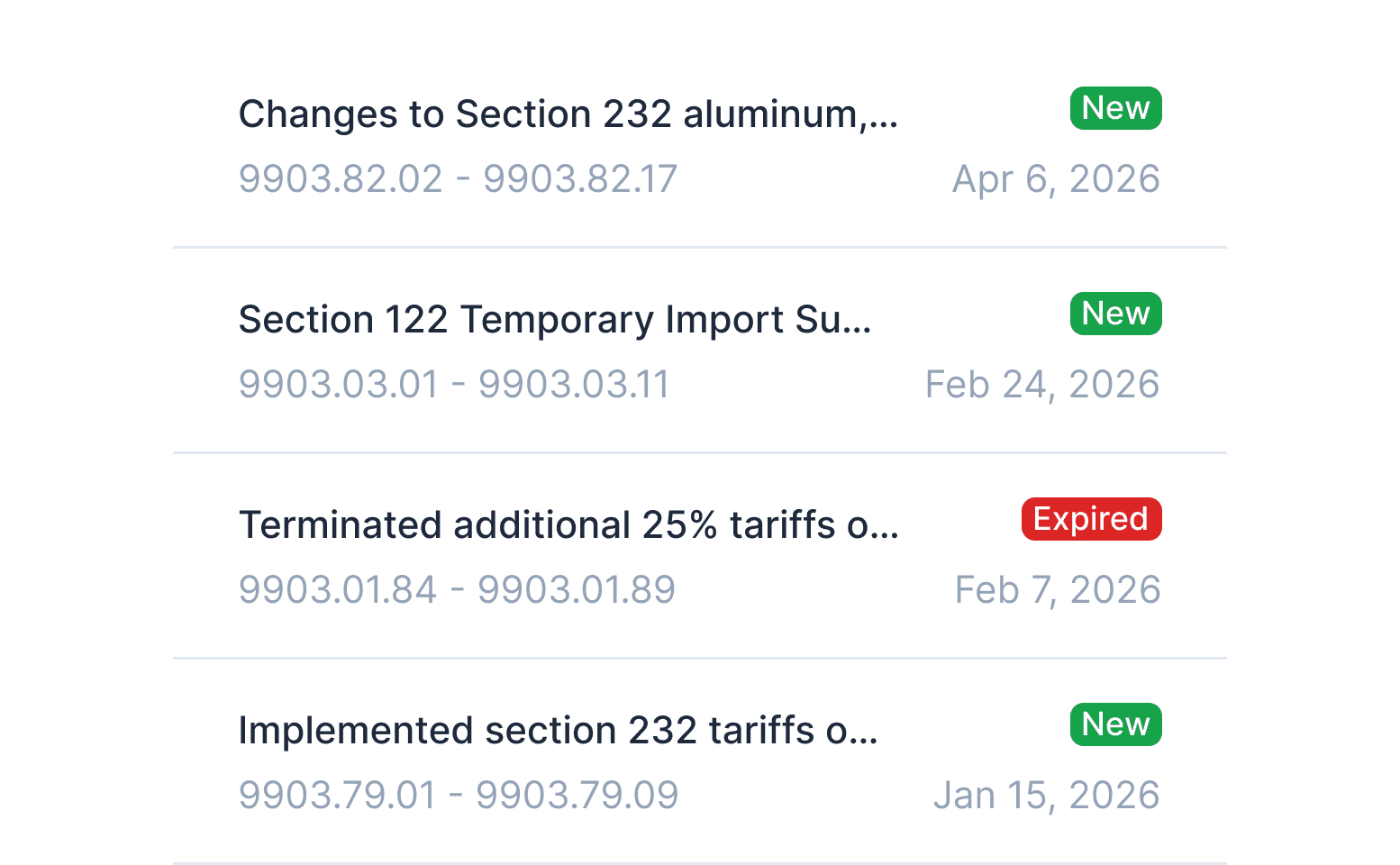
Cervo's tariff engine classifies goods at the 10-digit HTS level and automatically stacks all applicable Chapter 99 subheadings. The system automatically recommends the correct Chapter 99s based on country of origin and ensures the correct stacking order—a critical detail that manual processes frequently get wrong. The tariff database is updated in real time, so your entries always reflect current rates. For complex commodities, the parts library stores previously established classifications, ensuring consistency across entries for the same product.

Learn more about HTS classification automation

Section 232

Section 232 and Steel Split Automation

Section 232 entries require precise steel and aluminum content splits that are notoriously tedious to calculate manually. Each component of a product must be identified, its steel or aluminum content determined, and the correct duty rate applied to each portion. For multi-line entries with mixed materials, this can add 30 minutes or more to an already long process.

Cervo automates the entire split calculation. Material composition data is pulled from the parts library, split percentages are applied, and duty rates are calculated for each component. The result is an accurate Section 232 filing produced in seconds instead of half an hour. For entries involving both Section 232 and other Chapter 99 duties, Cervo handles the stacking sequence correctly every time.

Learn more about steel split automation · What is a steel split?

PGA Screening

PGA Screening and Auto-Population

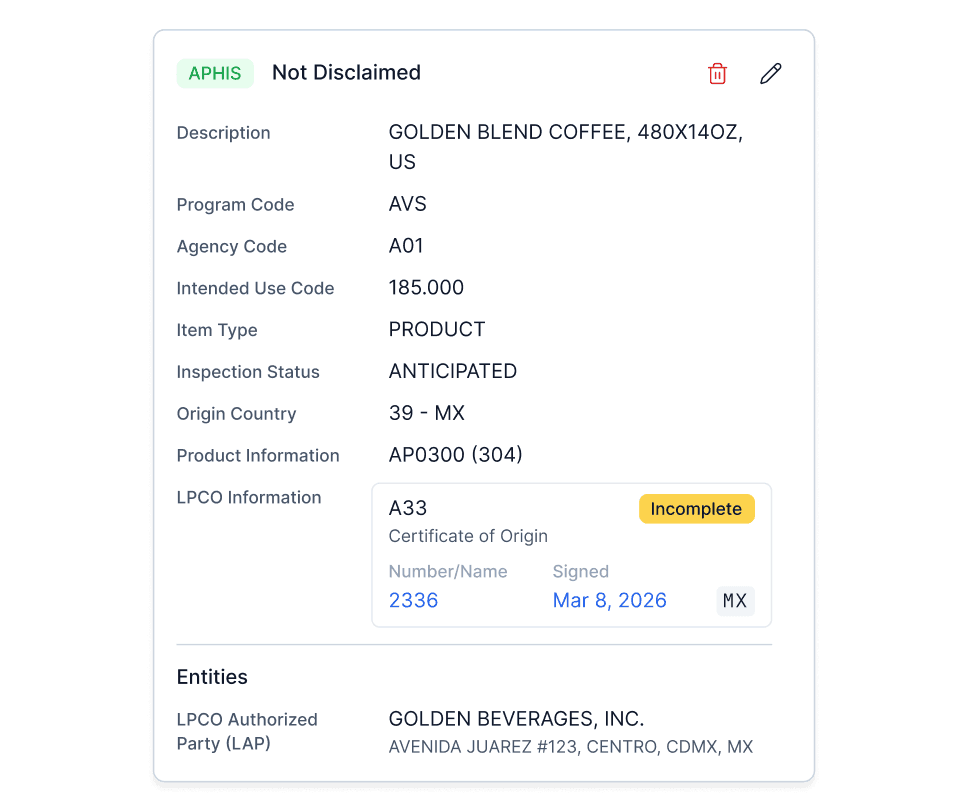
Partner Government Agency requirements from FDA, APHIS, AMS, EPA, FSIS, and LACEY each carry their own data fields, product codes, and filing rules. Missing a single PGA flag can result in an exam, a hold at the port, or a refused entry. Most brokerages rely on institutional knowledge to catch these requirements—a model that breaks down with staff turnover and volume growth.

Cervo screens every entry line against PGA requirements and automatically populates the required data fields. FDA product codes and prior notice, APHIS permits, AMS inspection requirements, EPA compliance data—all identified and filled without your entry writer needing to remember which products trigger which agency. Missing field flagging is configurable per broker based on what fields they require in their ABI, so the system adapts to your specific compliance requirements rather than imposing a one-size-fits-all checklist.

Learn more about PGA screening · PGA message sets explained

Agent Studio

Agent Studio: Per-Importer Customization

Every importer has quirks. Some use European decimal formatting. Some have pre-negotiated HTS codes that override standard classification logic. Some require fuzzy matching on part numbers because their invoices are inconsistent. Your senior brokers know all of this—but that knowledge lives in their heads, not in your systems.

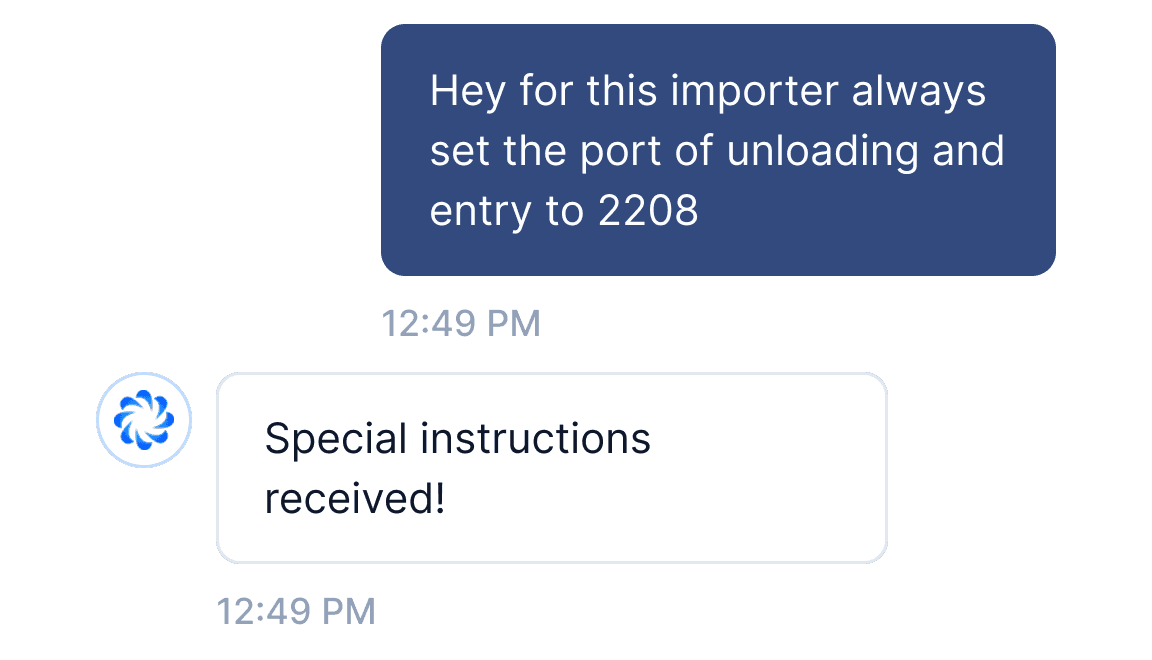
Agent Studio lets your team define per-importer rules in plain English, without writing code. Tell the system "for this importer, always use net weight from the packing list" or "flag any entry where the unit value deviates more than 15% from the 90-day average." The AI applies these rules automatically on every entry for that importer, ensuring consistency regardless of which entry writer handles the filing.

Learn more about Agent Studio

Parts Library

Parts Library: Your Brokerage's Knowledge Base

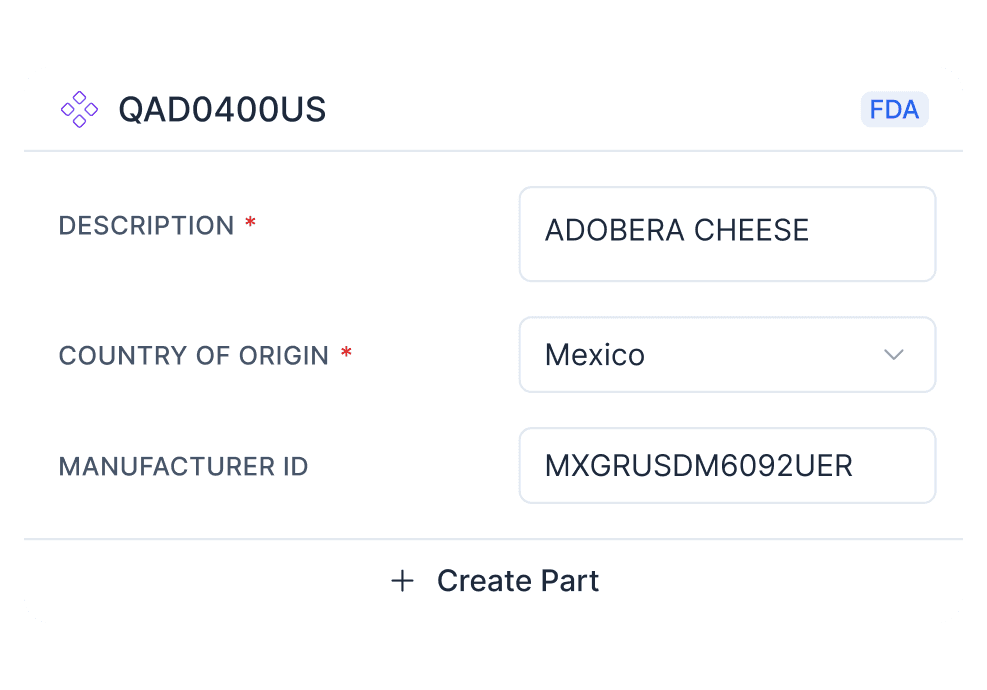
Cervo maintains a parts library that stores known products with their established HTS codes, PGA requirements, steel split configurations, and historical values. When a returning product is identified on an incoming document, the platform auto-populates classification and compliance data from the library.

This eliminates redundant classification work for recurring importers—which is most of your volume. The library builds automatically from processed entries, uses fuzzy matching to handle part number variations, and captures the institutional knowledge that would otherwise walk out the door when an entry writer leaves.

Learn more about the Parts Library

Results

Measured Results

88%
Time savings achieved by a top-3 global forwarder
2-10 min
From document upload to complete 7501 draft
45 days
Full implementation with proof of concept

Beyond Speed

  • Fewer post-entry amendments. Automated compliance checks reduce errors that require corrections after filing.
  • Faster onboarding. New entry writers learn by reviewing AI-generated drafts rather than building entries from scratch.
  • Better utilization of senior staff. Experienced brokers focus on exception handling, client advisory, and compliance strategy instead of data keying.
  • Predictable throughput. AI-powered workflows deliver consistent output regardless of staffing fluctuations or document quality.
  • Scalable growth. Take on new clients without proportional headcount increases. The platform processes entries in parallel at any volume.
Implementation

What Implementation Looks Like

Cervo is designed for a 45-day implementation cycle that starts with a proof of concept. During the POC phase, your team processes a representative sample of real entries through the platform to validate accuracy, measure time savings, and configure importer-specific rules in Agent Studio.

Integration with your ABI system is handled during implementation. Whether you use CargoWise, One View, NetCHB, or another platform, Cervo's team configures the data export to match your system's format. Most brokerages are fully operational within the 45-day window.

FAQs

Frequently Asked Questions

CTA Background

Ready to Automate 7501s?

See how Cervo AI can reduce your entry processing time by 80% or more. Book a demo and we will walk you through the platform using your own documents.
Book a Demo
45-day implementation. SOC 2 Type 2 compliant. No disruption to your current workflow.
Automate 7501s | CBP Entry Summary AI | Cervo